Passive Investing vs. Active Trading: Which Strategy Can Help You Build Wealth?
28.10.2026 18:37
A practical guide to ETFs, stock markets, trading, risk management and long-term financial independence.

Two people can enter the same financial market with completely different goals. One invests regularly and plans to hold assets for 20 years. The other trades price movements over hours or days. Both want financial progress, but their methods, risks and time commitments are very different.
1. Two approaches to financial markets
Passive investing
Building wealth gradually by buying and holding diversified investments such as ETFs.
LONG-TERM APPROACH
Active trading
Attempting to profit from short-term price movements using strategies, charts and market analysis.
ACTIVE MARKET APPROACH
Neither approach guarantees profits. The important question is which one matches your available time, knowledge, financial resources and attitude toward risk.
2. Passive investing: Let time work for you
Passive investing is based on a relatively simple principle: invest consistently, diversify and avoid unnecessary trading.
Instead of trying to predict every market movement, investors purchase assets intended to grow over longer periods.
Popular choices include broad-market ETFs tracking indices such as the S&P 500, global equity indices or the Nasdaq-100.
The Nasdaq-100 provides exposure to major non-financial companies listed on Nasdaq, but is more concentrated in large technology and growth businesses than a broad global index.
The power of regular investing
Consider a hypothetical investor contributing €100 every month for 20 years.
Illustrative investment projection
Monthly contribution
€100
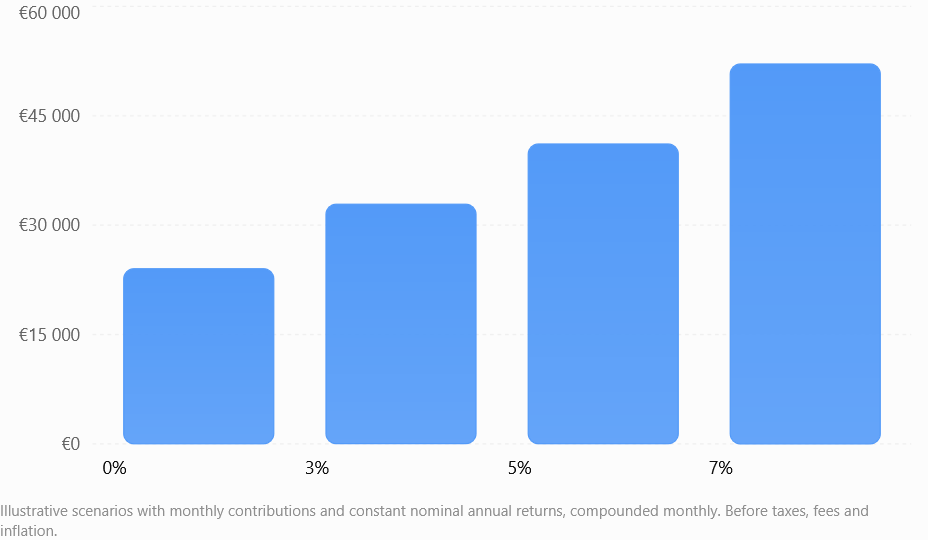
Investment periodIllustrative scenarios with monthly contributions and constant nominal annual returns, compounded monthly. Before taxes, fees and inflation.
Total contributions: €24,000. The returns shown are mathematical scenarios, not forecasts. Actual returns fluctuate and losses are possible.
The main lesson is that consistency and time can be powerful. However, compounding works best when investors keep costs under control and avoid withdrawing money unnecessarily.
3. Active trading: More flexibility, more responsibility
Active traders attempt to benefit from shorter-term market movements. They may trade stock indices, currencies, commodities or individual shares.
Trading strategies can involve technical indicators, price action, market news, trend-following or automated trading systems.
Some traders hold positions for minutes, while others keep them open for days or weeks.
Trading offers flexibility, but it also introduces additional challenges: frequent decisions, transaction costs, emotional pressure and the risk of substantial losses.
Five essential trading principles
01
Use a defined strategy
Know when to enter, exit and avoid a trade.
02
Control position size
Set risk limits based on your capital, not your desired profit.
03
Track performance
Measure net profit, drawdown, profit factor and trading costs.
04
Test before going live
Use historical testing and a demo account, while recognising their limitations.
05
Protect your capital
Avoid excessive leverage, revenge trading and trading without clear limits.
4. Passive investing vs. active trading: Key differences
|
Feature |
Passive investing |
Active trading |
|---|---|---|
|
Typical horizon |
Years or decades |
Minutes to weeks |
|
Time commitment |
Usually lower |
Usually higher |
|
Main objective |
Long-term wealth accumulation |
Profit from price movements |
|
Common products |
Stocks, ETFs |
Stocks, futures, CFDs |
|
Main challenge |
Patience during market declines |
Consistent execution and risk control |
|
Costs |
Often lower |
Can accumulate quickly |
|
Leverage |
Usually unnecessary |
Sometimes used, increasing risk |
|
Beginner suitability |
Often more accessible |
Requires greater preparation |
A particularly important distinction is between trading the actual underlying asset and trading a leveraged derivative such as a CFD.
CFDs do not provide ownership of the underlying shares or ETF and can lead to rapid losses. They should not be treated as a simple substitute for long-term investing.
5. Can you combine both approaches?
Yes. In fact, some experienced market participants separate their finances into two independent portfolios.
Portfolio A — Long-term investments
Portfolio B — Active trading
The purpose of separation is to prevent short-term trading losses from jeopardising money reserved for long-term financial goals.
For many people, passive investing alone may be sufficient. Active trading is optional, not a requirement for financial success.
6. How much money do you need to begin?
You do not necessarily need thousands of euros to start learning about investing.
Some brokers offer fractional shares or ETFs that can be purchased with relatively small contributions.
Before investing, however, it is sensible to build an emergency reserve, manage expensive debt and determine how much capital can remain invested for several years.
For active trading, starting with a demo account is often more useful than depositing money immediately.
A small live trading account can still involve significant percentage losses, particularly when leverage is used.
7. Choosing the right broker
Broker selection should follow your strategy, not the other way around.
For passive investing, consider access to real stocks and UCITS ETFs, custody arrangements, transaction fees, currency conversion and regulatory protections.
For active trading, examine execution quality, spreads, commissions, available instruments, platform stability, demo accounts and risk-management tools.
Broker comparison — coming soon
We are preparing a comparison of investment and trading platforms, including their product availability, costs and important risks.
Future affiliate links, where used, will be clearly disclosed. A commission relationship will not determine which products are suitable for readers.
8. Which approach is right for you?
Quick strategy finder
Your starting point
Educational guidance only, not a personalised financial recommendation.
9. Final thoughts: Wealth building is not a race
Passive investing and active trading are not enemies. They are different tools designed for different objectives.
Passive investing generally emphasises patience, diversification and long-term compounding.
Active trading focuses on shorter-term opportunities but demands stronger risk controls, continuous evaluation and emotional discipline.
For most beginners, learning the fundamentals of diversified long-term investing is a sensible first step. Those attracted to trading should begin with education, structured practice and realistic expectations.
The best strategy is not the one promising the fastest profit. It is the one you understand, can afford and can follow consistently.
Educational disclaimer: This article is for informational purposes only and does not constitute personalised financial advice. All investments involve risk. CFDs are complex leveraged products and carry a high risk of rapid financial loss. Past performance and hypothetical projections do not guarantee future results.
Webporadca.net — Practical knowledge for smarter financial and life decisions.


 Ako si vybrať auto ? tu najdete stovky


